I have been reading Catherine Beecher's (sister to Harriet Beecher Stowe) book The American Woman's Home, which was a free book available on the Kindle. I've been wanting to read it since it was referenced in my favorite housekeeping book, Home Comforts. It's been amusing.

It shows me that weird attitudes about housekeeping, food, and childrearing have been mixed in with sound advice as far back as 1873... and what's more, that they're the same weird attitudes I've met in modern, "anti-establishment" books. For instance, there's the idea that certain things that may or may not be Stupid Ideas, i.e., corsets or eating food the author deems unwholesome (hot bread), are not only Stupid but Evil and Sinful. Modern books are usually a little more subtle about condeming things morally that, honestly, even if the authors are correct are only dumb, not sins, but Beecher is a Victorian and a Transcendentalist and has no problem whatsoever with saying something is a sin.
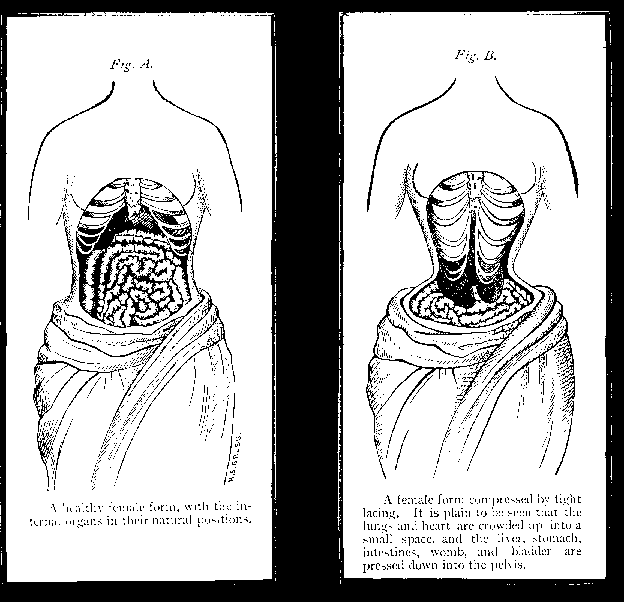
Take corsets. While I agree that wearing one is probably unhealthy and definitely uncomfortable, and while this picture should be enough to convince anyone that smushing your waist every day is a bad idea, I wouldn't go so far as to say that people who sell corsets are murderers. Maybe they're just dumb, disagree that corsets are dangerous, or in fact are right and corsets are merely uncomfortable and not death by whalebone. (Incidentally, loss of the whaling industry probably had more to do with why corsets went out of fashion than scads of women realizing that they were squishing their intestines down into their pelvi.)
 ]
]On the other hand some of her advice is sound and universal---things like, if you want to run a cheeful household:
1. Get up early.
2. Speak kindly, no matter how annoyed you are, because interruptions ARE going to happen--and if you can't say something nice, don't say anything at all, even to kids and servants.
3. Get most of your housework done before noon.
4. Arrange your work areas so that you don't have to take extra steps.
5. Spend more thought on making nice bread, meat, and vegetables than you do on making desserts and extras, and your table will be better furnished.
6. Decorate with what you can afford, but don't buy anything that isn't pretty.
C.S. Lewis advises that we read old books as an antidote to the myopia of the new ones, which after all share all of our own prejudices, biases, and viewpoint squints. The old books have prejudices too--Beecher is awfully sniffy about Irish servants--but the old prejudices are easy to see, because we usually don't share them. Beecher's chapter on servants contains a long lecture on why domestic service was, or ought to have been, different in America than it was in Europe. In that chapter she points out basically that servants are people too, and that the condescending manner that many employers treat them is, in fact, inappropriate. She then proceeds to demolish the ideas that lead to the condescending manner.
It struck me that the condescending manner that most people used to have toward their "help" is exactly the same manner that a lot of people have toward women who stay home to keep house, and that it comes from the same wrong ideas--that domestic work is easy (but also drudgery), boring, mind-numbing, and that people who engage in it should be directed by those who don't--and grateful for the direction!
Made me feel awesome about ignoring magazine articles about organizing my photos written by women who have two nannies and three housekeepers, or TV spots about children's needs done by people who see their kids on alternate weekends.
A lot of the hysteria you find in housekeeping/childrearing advice appears to have simply been regurgitated since Beecher's time, and if you think about it, the advice is very Transcendentalist. I doubt Beecher originated the theories, either.
So if you have a Kindle or other access to old books, I recommend taking your controversy of choice and looking up what the Victorians (or older) had to say on the subject. It might be illuminating to see exactly how old the new ideas are.
Cheers,
Breanna


No comments:
Post a Comment