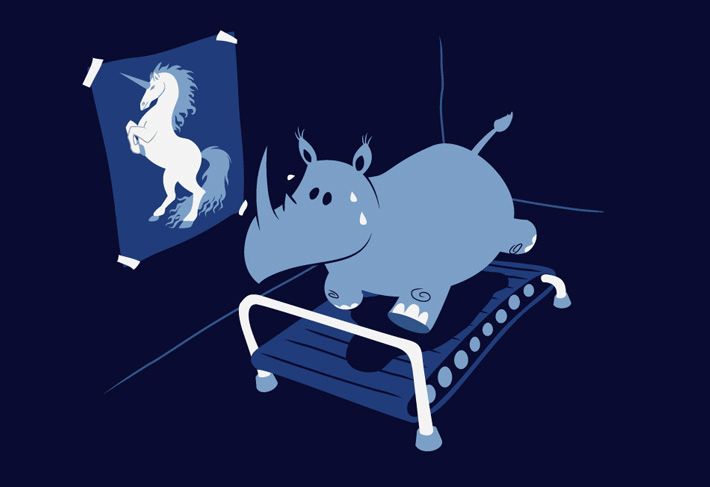
Do you think this poor rhino is ever going to look like the unicorn, no matter how long he runs? What about when you consider that unicorns don't even exist?
In a preview I read of a book that I'm impatiently awaiting Amazon to ship me, Healthy At Every Size, the researcher who wrote it talks about sitting down with the women who agreed to be part of her clinical trial. As is the nature of well-designed studies, half of the women were assigned to a "diet" group that did your standard low-fat, high-fiber, blah blah diet. The other half were assigned to the "Health At Every Size" protocol, which is basically about normalizing something called "eating competence" --i.e., convincing women that it really is okay to enjoy their food, trust their bodies, not weigh themselves, and that it would be okay if they didn't lose weight.
Because, in fact, losing weight and keeping it off below your body's setpoint is not possible.
One woman in the study shared how depressed she was to not be in the diet group, because she had thought being such a highly controlled diet would be sure to make her lose weight. Then she got to thinking: why am I so depressed? Why do I want to lose the weight so badly?
What motivates us to keep trying? I'm short and I don't like that, but I don't read growth books, attend heightening groups, or consider going to a salon to get stretched. That's because I just don't see my height as changeable. But weight is different. It seems like I should be able to change it.
When I start a diet, I have a feeling of hope. I was on a real high on my way to that first meeting. I let the fantasies run wild...I'll finally lose the weight. Guys will notice me as I walk by, my mom will say how proud she is, I'll have confidence when I apply for a job.
And then I heard Dr. Bacon say that weight loss may not be possible and would not be a goal. I felt like I had just been popped...Life didn't seem to be worth living without the hope that I could be thin.
But as this thought crossed my mind, it helped me see the extent of my magical thinking, how much I have been riding on the fantasy, why I keep trying so desperately to lose weight. Inside, I believe weight loss is the only thing standing between me and happiness. So if I never get thin, I can never be happy, I can never be the person I want to be. In that moment, I understood--it was the dream of weight loss that clouded my ability to be happy with myself, not the weight itself.
When you read, a while back on the blog, that there has NEVER been ANY diet EVER that worked, EVER, and that weight is mostly genetically determined, were you relieved or discouraged?
If you were like a lot of people, I bet you were discouraged until you started thinking about what it meant. Ironically, in weight as in all other things we try to control but really can't, the releasing of the illusion of control produces not chaos but freedom.
Need some examples of other things we try to control that aren't really amenable to control?
1. Talent--no matter how hard I try, I can't roll my tongue the way my brother and sister can, so that it looks like a piece of bologna. I grieved about this quite a bit at age 8 or so. More seriously, people spend a lot of money and heartache trying to force themselves into a particular talent slot, usually because someone they admire wants them to. (I'm looking at you, little league dads, and you, stage moms.)
2. Spirituality--again, no matter how hard I try or which mnemonic tricks I use, I don't do well at memorizing Scripture unless it's set to a song. Set it to a song, and then I can memorize it as easily as you can recite "867-5309". For years I felt this method of Scripture memory didn't count. Then I realized that since 1) this is the exact way that monks memorized all 150 Psalms in the middle ages and 2) I'm not competing in an AWANA program, it doesn't matter that "put an index card on the bathroom mirror and repeat the verse while you brush your teeth" doesn't work for me. And it's silly to envy the people it does work for.
3. Kids--sleeping, specifically. You can lead a kid to bed but you can't make him sleep. This becomes obvious if you think about the fact that you can't even actually make yourself sleep when you're not sleepy, but there are countless books who assume that if your kids are up late, even if you've provided good structure you are doing something wrong.
4. Global warming/the environment--we're just not so big that the emissions we make can wreck the whole planet.
5. Relationships--everyone knows, superficially, that you can't control the people in your relationships. But the amount that we try anyway is evidenced by both personal experience and the plethora of articles on things like, "how to get your man to remember your birthday" and "get what you want...without nagging" and "five tips to a more intimate marriage".
The idea that we should control something that is actually impossible for us to control is a source of great effort, pain, and frustration. It's also the original deception.
It's my contention that as creatures we really aren't ever in control, except when the Lord delegates very specific portions of control to us. We are either controlled by the Lord, or by sin. We don't have the option to control ourselves--we never have--that was what the lie in Eden to "be like God" was about.
In another irony, it's the bits of control the Lord delegates to us that we generally insist are out of our power: controlling what we say, for instance, or whether we let our eyes linger lustfully on someone, or whether we'll nurse an unforgiving thought or reject it. Those things, which God tells us to do in Scripture, we insist are beyond our control.
But the other stuff? In spite of repeated failures and overwhelming evidence to the contrary, we insist we can, if we just apply the right formula, control almost everything else about ourselves.
The lure of this is the same as the lure of any kind of self-defined righteousness. Those of us who are relatively thin can, with social approval, look at fatter people as proof that we are Good and they are Bad. Those who have the kinds of lives that allow for a two-hour quiet time per day can (God forbid) look smugly at the single mom with two jobs and four kids who gets a verse every two days, and feel sure they are more spiritual. Those who eat only organics can look down on those who can only afford Ramen and the occasional Twinkie, and those who practice "simplicity" can look down on the person who secretly loves Precious Moments figurines.
It's all a lie. Whenever we make an external measure the definition of righteousness, we're falling into the same trap that the New Testament church did in regards to circumcision. While some of the markers we use to judge others may indeed be desirable things to attain, when we make them the measure of our value we make them into idols, pure and simple. As a society we've done this with weight in a huge way--and if you don't believe me, just listen to the way people talk about fat people for about a week. In the American church, we're not much better.
(Witness all the "Christian" weight loss programs that say that if you are fat, you're not only lazy, uninformed, dumb, and sick, but in sin. They quote that "body is a temple" verse and don't ever bother to mention that, in context, Paul is talking about whether one should have sex with prostitutes. Um. Does not seem to generalize well to food to me...)
Let's repeat again: even though it seems at first that if we let go of control, we will spin into chaos, the result of admitting that God is in control is not chaos, it's freedom.
Freedom to quit, as C.S. Lewis puts it, all the "posturing, and preening, and aren't-I-a-good-boy?" Freedom to stop spending our lives on meaningless, unwinnable pursuits. Freedom to think about something else, for Pete's sake.
I wish I was further along myself. I still feel weird if I'm in a restaurant with littler women and they order something like a chicken salad, while I order a big ol' burger and fries because I'm starving. I feel like they're looking at my plate and internally raising an eyebrow. (Maybe they are, who knows; more likely they're just eying my fries because they're hungry.) I still order the burger; I'm hungry. It's one more thing to trust the Lord with.
Let's close with a little catchphrase that popped into my head this morning. To be a little bit like the Oracle in Mystery Men, "Whatever it is you try to control, winds up controlling you."
Something to think on.
Cheers,
Breanna


No comments:
Post a Comment