Showing posts with label Type 1 Diabetes. Show all posts

Thursday, May 23, 2013

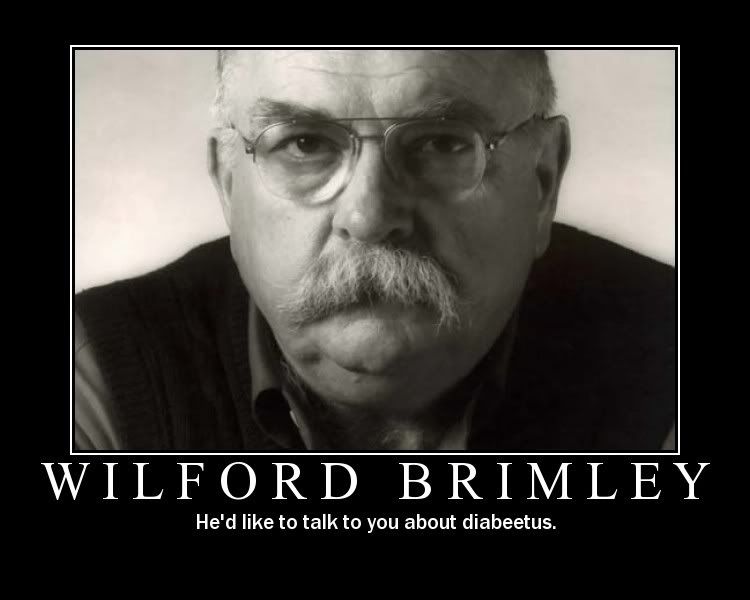
DIABEETUS

(They also have this as a T-shirt with his picture, that simply says DIABEETUS.)


We're doing fine. Buddy's blood sugars have been somewhat all over the place, but that's (they think) because we are in the Type 1 "honeymoon period" where what's left of the beta cells in his pancreas provide one more pitiful, last-gasp burst of insulin.  I am sort of resentful toward those cells, for making my calculations more difficult.

But at least we have our own jam:


Poor Mr. Brimley.  I really shouldn't find all of this so funny, but I DO.

I promised to explain Type 1 diabetes, so I will.  (With graphics!)  Are you ready?

First, here's some British kids with Type 1:


They do a good job of explaining the symptoms.  The cause is annoyingly simple:

In a person with a healthy pancreas, a little bunch of cells at the bottom of the pancreas called the beta cells (also called "the Islet of Langerhans" for the person who discovered them--but I mean, "islet"? what, "island" was too lowbrow?) makes insulin.  A bunch of different systems monitor your blood sugar--your liver, kidneys, pancreas, and brain all pay attention--and when it goes up, your beta cells release insulin to bring it back down.  When it goes down, your liver releases glucose to make it go back up (until it uses up its glucose reserves and you are hungry, and your body tells you to eat).  Simple, yes?

Basically Type 1 diabetes is an immune disorder.  For some reason, your immune system takes it into its head that the beta cells in your pancreas are something to attack (much like this).  Scientists are still speculating about exactly why the immune system starts doing something of no earthly use to anyone.  It's sort of genetic but not really; it might be a virus (or it might not); or it might just be a mistake in the software, so to speak, in your killer T-cells.

Short answer: "Well, we know what happens, but danged if we know why, exactly."

(Type 2 diabetes works in a completely different way--they should really be classified as different diseases, but aren't because medicine keeps its historical diagnoses even after we realize they're dumb.)

So, in a Type 1 diabetic, they eat and the calories go into their bloodstream, but there is no insulin to get that nutrition actually into their cells.  This leads to problems:

1) The cells are really, really hungry--especially the brain, which can only run on sugar.  So you feel weak and fuzzy-headed.  In Buddy's case, he lost a bunch of his fine motor control (coloring was where I noticed it) and he went backwards on his phonics.  This makes sense when you realize he felt the same way that you do when you don't eat all day and then try to do something delicate--pen and ink drawing, say--at 5pm.

2) The amount of glucose (sugar) in the blood is really, really high, and the body does not like that--the kidneys, which did not get the memo that the pancreas is in trouble, manfully try to take up the slack and decide the answer is to pee off all the extra sugar.  And electrolytes.  And water.  So you get--

3) Really really dehydrated, and

4) Your blood turns really, really acidic.  This is what leads to the condition called Diabetic Ketoacidosis (DKA), which basically means that your blood is so acidic that it starts damaging your tissues (and brain).  If DKA isn't corrected, you'll go into a coma and die.  Yup.

The answer to all these problems?  Insulin injections.  Well, math and insulin injections.

Once you have insulin, the sugar can get into your cells, your kidneys can go back to doing their old job, your liver doesn't keep dumping glucose that you don't need into your blood, you can think, use your fingers for fine tasks, and run and jump and climb trees.

One big difference between type 2 diabetes and type 1 is that type 2 can improve when you lose weight and exercise.  Not type 1--while you should try, of course, to be active and eat healthy as a type 1, you can be a professional athlete and it still won't make your pancreas start working again.  Right now there is no cure.

However, medicine has been expecting to find a cure for years.  It seems like a disease that you should be able to solve with, say, transplanted beta cells, or cloned beta cells, or something.  You can, reading the professional literature, almost taste the researchers' frustration.

What's a day in the life like?

We get up and, by 8am, check Bud's blood sugar with a fingerstick glucometer that has a cool feature--it lets you download the sugars to your computer.  Then I make him breakfast and he gets two kinds of insulin:

-long acting insulin called Lantus--this mimics the baseline of insulin that a healthy pancreas keeps in your bloodstream all the time.  He only has to have Lantus in the morning right now.
-short acting insulin called Humalog--this mimics the spike in insulin that you get after you eat and your blood sugar goes up.  This insulin he gets whenever he eats, and this is the one that needs the calculations done.

For instance, this morning he had scrambled eggs (0g carbs) and toast (15g for one slice) with butter (0g) for breakfast.  His insulin ratio is 1/2 unit of Humalog for every 15g carbs he eats.  So normally I would give him an injection of 1/2 unit of Humalog.  (This is an extremely small dose, by the way.)

BUT--here is where the math comes in--this morning when he woke up his blood sugar was low (71). The doctors gave us a range in which to keep it (100-200).  So instead of giving him short-acting insulin this morning, I gave him juice (15g for half a cup).  Then I waited 15 minutes, checked his sugar again (he was still low--84) and let him eat his toast without short-acting insulin.

You can see how things get a bit wild and wooly.  He's been low all day, actually.  Me and the diabetes nurse chatted (I get to call them any time, day or night, that I want) and agreed that Buddy's insulin dose was too high, and we lowered it.  We'll be measuring again at lunch, dinner, snack, and bedtime--and any time in between that Buddy starts acting fussy, hungry, sleepy, or weird.  (I mean, more fussy, hungry, sleepy, and weird than your average four-year-old.)

If all of that still makes you scratch your head, try reading this book.  It's very clear and easy to understand, and is the best type 1 book I've found yet.

Short synopsis?  We're doing fine and getting used to it.  Yesterday we went to our play group, McDonald's, and soccer, and managed the insulin just fine.  Life goes on...just with more math.  (Praise God.)

Cheers,

Breanna

Monday, May 20, 2013

Ordinary

I read an article yesterday that made the assertion that being "radical" and "missional" is "the new legalism".  (And makes a troubling snide comment about people who choose to adopt instead of having biological children.  I mean, honestly, that is your business...how?)

Now, I get where the guy is coming from.  I've felt that not-so-subtle pressure, too--like, I have a nice house; should I go all Francis Chan over here, sell my nice house (presumably to someone who isn't a Christian) and give half the money away?  (No, I don't necessarily think Chan himself was applying that pressure; I've run across it in blogs etc.)

But I disagree with this statement from Bradley's article:

"For too many Millennials their greatest fear in this life is being an ordinary person with a non-glamorous job, living in the suburbs, and having nothing spectacular to boast about."

I would say, in the first place, that this tars a whole generation of people with one brush.  I know plenty of Millennials (I think I am one?  I can never get these generational names straight) who really, if you ask them, just want a steady job, a house in the suburbs without crushing debt, and an intact family.  We've come of age during a time when the economy has sucked, when divorce is the norm, when a foreign war has dragged on for 10 years and when terrorism has been a rational threat hanging over all our public interactions.  Are we spoiled?  Sure.  But recognizing we're spoiled and trying to share some of our advantages?  That's not necessarily a sign of pride.

It can be, of course.  But it can also be pride to look at someone who's concerned with "social justice" and concluding, "Well, he's obviously just in it because he wants to look good and impress his liberal friends."

Now.  I'm one of the first to admit that the people in the church who use phrases like "social justice" and "radical" are sometimes startlingly inept at actually helping people and they sometimes don't have enough background in poverty to know what they're doing.  Even selling your house, giving away half the money, and living on the median income in the U.S. still makes you richer than 99% of the world--so for American Christians, whatever "social justice" means, we will have to grapple with affluence.  Maybe the correct response is giving most of our stuff away.  Maybe not--but the conversation is going to be really difficult if both the "radical" people and the "suburban" or "traditional" people are accusing each other of having a hidden agenda--especially when they are mostly recommending the same behaviors.

For instance, I found it a little mind-bending to realize that one book proposing that Christians be more radical relative to the culture was in fact suggesting nothing particularly extreme.  (Read your Bible all the way through, tithe, pray, go to church, and serve in the local church.)  As the Sunday School song I grew up with put it, Read your Bible and pray every day, pray every day, pray every day.

Here is what I think:

Labels are unhelpful.  Ordinary "suburban" people have plenty of opportunities to be "radical" and to effect change for generations to come.  Living for the Lord means doing that in whatever circumstance He puts you in--not necessarily moving to a commune.  If He tells you to sell your house and buy a cheaper one, well, of course that's what you ought to do.  But maybe He wants you to keep your nice house and actually witness to your neighbors.  (Even the suburban ones.)  Given that, a lot of the time, we would rather minister to people who are clearly different from us (see the settlement movement), it can actually be more challenging to show your Christianity to your physical neighbors than it is to go to a soup kitchen and help wash dishes.  Or here's an idea--do both, but without sniping at Christians whose call is different than yours.  The fact is that any actual living out of the commands of Christ is going to look radical relative to our culture, even when it's ordinary people doing it.

Secondly, I don't think it matters whether you are serving God in the city or in a small town.  Yes, the Shane Claibornes of the Christian lit world have a burden for cities.  I suspect that's not because they despise those of us in small towns or suburbs, but because they are from cities--their formative years have been spent there--and that's where they live now.  It doesn't matter; if their ideas are bad, they are bad for cities as well as for small towns.  If their ideas make sense, they make sense in both places (but with different applications).  Many of the same challenges that exist in cities exist in small towns.  For instance, I live in a town of 10,000 people.  We have prostitution, gang violence, drug and alcohol problems, worldliness, pride, racism, xenophobia, a severe lack of intact families, apathetic churches, and poverty.  But there's also this: in a small town everyone knows everything about everyone--you have to live your Christianity, or everyone will know you are a hypocrite.

Thirdly, I think the correct response to Claiborne and David Platt and Francis Chan is not to get in a miff that they are making too many people think they are special snowflakes.  It's like any other human book, right?  Parts of it are going to be right, and parts are going to be wrong.  So eat the fish, man, and spit out the bones.  If you really think they are promoting heresy, then say so.  (But without the snark, please.)

So how to approach it, then?  Well, I think the problem is overblown.  It's simple: in the life where you are now, serve God.  Ask Him what He wants you to do, then do it. 

Here's the thing.  People get stuck focusing on one extraordinary aspect of someone's life--selling the house, starting the commune--instead of the principles behind it.  (I notice they do this even when the author specifically says "look, you are probably not called to give away your house like I was".)  I suggest that instead of defending ourselves (either from the crazy liberal radical people or from the crazy stuffy traditional people) we just get on with doing what we think God has called us to.  In my life, right now, we're called to demonstrate how Christians handle type 1 diabetes.  God has provided a surprisingly large number of opportunities to give Him glory, to trust Him, and to refuse to rail against His sovereignty.

I can't explain the bad stuff.  I have no idea why my sweet little boy had to get this disease.  But I know it didn't just happen to him; I know God wasn't surprised, and I know He's not malicious.  And I know He has something He wants me (and us) to learn, to do, to demonstrate for His glory--even in the middle of the grief and the temptation to fear and the sudden concern with money and medical bills.  Is that radical, or ordinary?  Did this happen to my kid because I was just so worried about being a special snowflake, or because I was too apathetic and satisfied with my Christian Country Club?

No.  Because at the end of the day discerning which social movement I'm a part of is a waste of time.  I have laundry to do (with a thankful heart), insulin doses to calculate (while placing myself under God's hand), and people to pray for (while clinging to His mighty promises).  The debate looks pretty stupid, honestly.  If a book has helped you, great.  If not, well, read your Bible, pray every day, pray every day, pray every day.

Cheers,

Breanna

Tuesday, May 14, 2013

Our Type 1 Diabetes Diagnosis Story

I'm writing about it while it's fresh in my mind so that if anyone Googles this (see the very specific post title) they will be able to compare their child's symptoms to Bud's, and maybe get in to see the doctor more quickly than they might otherwise have.

Because, in retrospect, it's obvious.


For one thing, he always has had a massive sweet tooth, but it had gotten really nuts in the last month or so.  To the point that he would ask me, "Mama, I want something sweet" or "Mama, I need a sweet drink".  To which I usually said no, but take this as point one.

He had also been going potty about every 20 minutes for about a week.  I thought maybe it was a bladder infection and started giving him cranberry juice until we could get into urgent care.  But this was strange potty--so frequent, and he began having accidents again, which he hadn't had during the day for almost a year.

On Friday he wasn't speaking as clearly as normal.  While getting him ready for bed, his daddy remarked that he seemed skinnier than ever (he has always been skinny), and I was worried by how pale he looked--there were dark circles under his eyes, and I felt like you could see all his bones.  He kept climbing into my lap and saying "Mama, my eyes feel sleepy."

On Saturday I rushed him to the doctor because he looked like this:

That's him trying to smile for me, not even reacting to the IV in his left arm.  At this point all he would do is smile, whisper, and tell me that he had something in his eyes.  (Later we would learn that high blood sugars can blur your vision.)

The hospital started an insulin drip and called the flight nurses to get us to Salt Lake via air ambulance. 

 Here he is after being on the insulin drip for a couple of hours:

Still not completely with it, but enough there that he could smile at me with both eyes, and...

...that he could play games on flight nurse Kelly's cell phone.  (God bless flight nurse Kelly!)


Here he is in ER in Salt Lake, still on the drip.


And our first breakfast, after we got off the drip.  He ordered everything he could think of, and the hospital brought it to him.  He's loving food lately, which makes total sense now that his body can actually use the nutrition he consumes.

One of the things that has surprised me the most is what a difference this has all made in his moods.  He's always been a sweetheart, but over the last month or so (seeing a trend here?) he was fussy and fragile--which I thought was just due to turning four, or something--but by fragile I mean crying because he couldn't have the cup he chose, or something like that.  Now he's himself again, goofing off with his sister, snuggling me, and drawing.  He got sick so slowly that I hadn't realized how much stuff he had just quit doing.

This is the "something in my eye" position, although at this point he was healthy again, just waking up.

He's also been sleeping a lot--recovering, I think.  I know that's how I feel.


And now, for the family:

Things to Thank God For:

1. Our medical team advised us to call the insurance company and make sure that everything that needed to be preapproved was preapproved.  I did, and the representative I talked to was a little offended that I wondered whether or not they covered diabetes education/hemoglobin A1c/insulin pens.  OF COURSE they cover those, I was advised.  Apparently we have Cadillac insurance, and all this time I thought we were driving a Buick.

2. Buddy has to get injections every time he eats.  Last night was the first time he didn't cry.  Today's injections have been better, even though he does cry a little bit.  He's already fine with the finger-stick to check his blood sugar, and has fun telling us which finger to use, and exactly where to "snap" the finger to get the blood droplet.  He likes his blue glucometer.

3. We all slept all night.

4. Since we got home, Buddy's blood glucose measurements have been perfect--right where they're supposed to be.  This is encouraging, because in the hospital they were continuing to run high.

5. The pharmacy was very helpful about ordering 1/2 unit syringes.  (Buddy is so small that his insulin doses are correspondingly tiny--sometimes he only gets 1/2 unit at a time.)

Things to Keep Praying For:

1. Pray the injections keep getting easier.

2. Pray that I get some energy back.  I got all the way through getting everybody home and dealing with the pharmacy, and then all the pep seemed to ooze out of my body.  Probably my adrenal glands are just wrung dry of adrenaline, and my body is making the point that no more running is going to happen.  Also I might have a cold, Miss Boo and I both have a cough.

3. Pray that we get used to keeping meals on a schedule, measuring everything, and doing calculations.

Cheers,

Breanna

Monday, May 13, 2013

All is Well, and All Manner of Things Will Be Well

I don't have the right cord with me to post a picture to the blog (you'll get them, don't worry!) right now, so this is just a note to describe to you what I can see as the sun is coming up here in Salt Lake.

Out the window are swallows eating bugs.  (Buddy thinks they're hilarious.)  They live on the wall of the parking garage opposite my window, which actually has quite a nice view because the garage has been covered in trees, vines, and grass.

On the wall is a picture of two cheetahs snuggling.

On the bed is one giant box of Star Wars Legos (that we haven't opened yet, we are just looking at it and sort of HAVING it) and a boy who slept all night near the giant box of Star Wars Legos.  He's still sleeping, rosy-cheeked, happy, and perfectly healthy except for a pancreas that, as he puts it, broke.

So Daddy and I are going to be Bud's pancreas until he can do it himself.  He's already surprisingly cool with everything--chooses which finger to "snap" to check his blood sugar (they have such a teeny, tiny lancet that I don't think he can hardly feel it).  Injections are still hard, but he decided last night that if we call them an "insulin pinch" that will help him remember that they don't hurt so much.  (They really don't--the needles are as fine as a hair--but after getting a blood draw and an IV, I wouldn't trust needles either.)  Buddy is brave, enjoying his new stuff, and eating like a trucker.  Or, as he put it last night:  "Mama, I had so much shots and so much fun today."

Mama and Daddy are trying to learn more than we did for college finals, acquiring a stack of books and a Team of experts, and a list of followup appointments to keep.

Here are some things to thank God for:

1. All His provision.  This has been amazing over and over.  From things like my background as a nurse, to the Husband's background in chemical engineering (the math is not a challenge for him), to the nurse at the ER in Nevada (she happened to have a child who was treated at the hospital we were sent to in Salt Lake, and kept telling us how great it was and that there was a big Spiderman statue, which was thrilling for the little man), to the awesome flight nurses, to the endocrinologist here, even down to the design of our fridge at home (perfect for insulin bottles) and the kitchen scale I got months ago to make soap (accurate enough to measure his food with).  God is so, so, so good.

2. All His care.  We caught it fast.  Bud was close to being at the point where he would have slipped into a coma, but he never did.  He was always able to answer me (although sometimes he didn't make a lot more sense than eye of the sparrow).  The nurse was able to get an IV with only two pokes (the first one blew because Buddy was so, so dehydrated).  The flight to Salt Lake was faster than the pilot thought it would be.  Bud's acid/base balance was messed up (I'll explain type 1 diabetes in a later post, this will make sense), but came into line so quickly that our Team was impressed.  Nobody can believe how great he's doing, considering that he was on an insulin drip when he came in to the hospital.  There's a letter by C.S. Lewis that signs off, "Under the Omnipotence", and that was exactly where I felt like we were.

3. The faithfulness of His saints.  I had time for two quick phone calls before I was in one ER, one ambulance, one airplane, another ambulance, and then another ER.  One was to the Husband to tell him what was happening, and one was to Grammy to tell her what was happening and to activate the family prayer chain.  But of course she did more than that--as near as I can tell we had thousands of people praying for us, from family, to the church(es!) in Montana, and churches all over the country.  We had 24-hour coverage and I could tell exactly when it started.  (I was in Utah, flying over the salt flats, looking down at them and thinking, "It seems like I should be more upset.  But Bud's smiling at me, I'm smiling at him, and I guess this is what they mean by peace that passes understanding.")

4. The trustworthiness of His word.  In my head two things kept rotating: the Lord's Prayer and Romans 8:37.  Thank You, Lord, for Scripture memory songs!

Here are somethings to keep praying for:

1. The Husband hates needles.  He's working on getting over it for the sake of his boy, but it's a real thing for him and it's hard.  Pray that it gets easier.

2. The other two kids have been troopers, but pray that they understand, and that the Husband and I can be wise, so they don't feel left out or marginalized.  Parenting is tricky--especially since this is a lifetime thing, so it's not like we can do the standard tactic of just spoiling the sick one while they're sick.  Because Buddy won't be sick, per se--just math-intensive.

3.There's a ton of things to learn.  Even though I'm a nurse, I wasn't a diabetic educator (yes, there's whole specialties you can do in this stuff).  There are machines to master, numbers to track, notebooks to buy and lists to type.  Pray that we will keep it all straight.

4. We have to get things straight with the insurance company.  So far there's not a lot of problems anticipated, but I'm going to have to get cozy with the patient rep and discuss scintillating topics like, is it cheaper to buy insulin in vials or pens? do you have a preferred pharmacy for us to go to? do you cover strips for the glucometer? which ones?  And so forth.  Pray the answers are favorable (I like the glucometer they gave us here at the hospital, and I don't want to switch to the giant clunky one).

5. And of course, pray that the little man keeps getting better (I know you are already).  This is something he will live with for the rest of his life, but it could be worse than living with the constant reminder that God is your Provider.

News for today:

It's looking like we will probably get to go home.  The endocrinologist was optimistic, given how good Buddy's doing and how (apparently) on the ball the Husband and I are.  (I think we are only *comparatively* on the ball, considering most parents who don't happen to have complimentary degrees in the chemical and biological aspects of their child's illness.)  We have another class with the dietician this morning, and then the typical rigmarole of hospital discharge and a 3+ hour drive home.  In two weeks we will have a followup appointment back in SLC at the diabetes clinic.  I'm going to get to know the (very easy, very straight-shot) drive from Elko to SLC very, very well.

I'll keep you posted, everyone.  We love you, and we love our great Savior.

Cheers,

Breanna