Yes, yes, yes, I'll post pictures of the kids in their Easter clothes. Just not today. I need to write about things today.
First of all, in pursuance of my recent obsession with "church time", or the liturgical year, we're going to celebrate Eastertide this year.
You may not know that Easter has traditionally been a season, like Advent, or that there's a whole set of meditations that lead up to it. Because of certain yucky things that have been happening in our local church lately, it's nice to be joining the communion of saints--i.e., all Christians everywhere--that is untroubled by such things.
And so we have three days this week to shop and plan and work, before we reach
Maundy Thursday. Sabbath observers don't by or sell on Sunday; they don't do work; and they don't pursue secular activities. I like football and I haven't been convicted that I need to use this particular spiritual discipline, but it's something to consider as we come to the most important Sunday in the church year. Originally Christians celebrated the death and ressurection of Christ every Sunday, after all. I am going to concientiously try (try! I have babies) to plan my week so that all my buying and selling is done, and all my housework is done, before sunset on Thursday. (Not cooking. Cooking I will be doing, but after all, someone had too cook the Last Supper, right?)
Sunset on the Thursday before Easter, the Tridium (or "Great Three Days") begins. On Maundy Thursday we remember the Last Supper, and Jesus washing the disciples' feet. Apparently some churches actually engage in a footwashing service on this night. Then, traditionally, the altar of the church, which is generally a decorated place, is stripped and shoved against the wall. This symbolizes when Jesus was stripped--of His clothes, His dignity, and His freedom.
We have no altar in our house, per se, and I'm pretty sure our little SBC church has never heard of the Tridium, but it might be a healthy exercise in perspective for me to get a warm washcloth and wash the two pairs of little tootises that I'm responsible for every day.
Come to think of it, I wonder why we don't have an altar in our house, or at least a corner devoted to prayer. Hm.
Good Friday is, of course, the Friday before Easter. We'll be celebrating a Seder on Good Friday evening, which the Husband leads in superb fashion. We're under the new covenent, so while we try to keep kosher for the meal, we alter the Haggadah a little. Instead of the whimsical rabbincal tale that our Haggadah ends with, my husband smoothly transitions to Corinthians, and serves us all Communion. It's incredibly meaningful every year.
Often in Protestant circles we don't celebrate Maundy Thursday or
Holy Saturday, which is what comes next, but it might behoove us to do so. Holy Saturday is the day that Christians have traditionally kept vigil, remembering the time Christ spent in the tomb. I can't fast this year, because I'm nursing a baby and there's all kinds of things that go wrong if nursing mothers fast, but typically the observance on Holy Saturday is a fast. We're doing the next best thing and having a day of simple food, a rest between the "festive meal" of Passover, remembering the first time the Lord freed His people, and the Feast of Easter, remembering when the Lord freed the universe.
Then, of course, comes
Easter. It's actually a little more difficult to make Easter meaningful than it is to make the days leading up to it meaningful. For one thing, nobody who isn't a Christian is going to be worrying what Maundy Thursday is, but everybody can get behind dying eggs and chocolate bunnies.
Like many Christian holidays, Easter took over from a pagan holiday--the festival of the goddess Ishtar, actually. This isn't a bad thing, or any kind of indictment against the holiday. We won, see. Nobody wakes up on Easter saying "Go Ishtar!" In fact, people who never otherwise attend church come on Easter. But there are remnants of the pagan holiday running around, just like the secular landslide of "The Holidays" between Thanksgiving and Christmas. Namely, the bunnies and the eggs, potent symbols.
--PG-13 REFERENCE COMING UP, HIDE THE EYES OF KIDS--
As the comedian Eddie Izzard says, "Eggs are for fertility and the rabbits are for shagging." (Sorry. But this is a grownup blog, not for kids.) In a C.S. Lewisan kind of way, this actually makes sense. Lewis had this theory that there were germs of truth hidden inside most of the old legends and pagan beliefs, like bits of information smuggled across enemy lines. The Lord could use these germs of truth to prepare people for the Gospel.
So, two symbols associated with the making of new life--eggs and rabbits--go very well with a holiday that is deeply about life, about the conquering of death, about resurrection. Granted the eggs and the rabbits were originally accessories of a tawdry pagan goddess, who had a story about like what you'd expect from a tawdry pagan goddess. But so potent is His death and resurrection that
even the dang eggs and rabbits have been redeemed. Get it?
I orignally mulled putting together an Easter basket for the kids without eggs or bunnies in it. They do sell chocolate crosses, after all, but standing in the aisle at Wal-Mart holding one made me feel vaguely sacreligious. (Chocolate? This is an instrument of torture and death. Why not make chocolate electric chairs and nooses while we're at it. On second thought, don't mention that to the candy makers, or I'm sure they could sell a lot of them on Halloween.) And hopefully, by the time we get to the eggs and the bunnies, the kids will understand on some level that this is all about Him, that our lives are all about Him, that the entire universe, in the end, is all about Him, and the central event that shook the heavens:
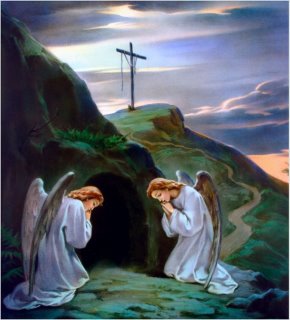
He is risen.
Cheers,
Breanna