 |
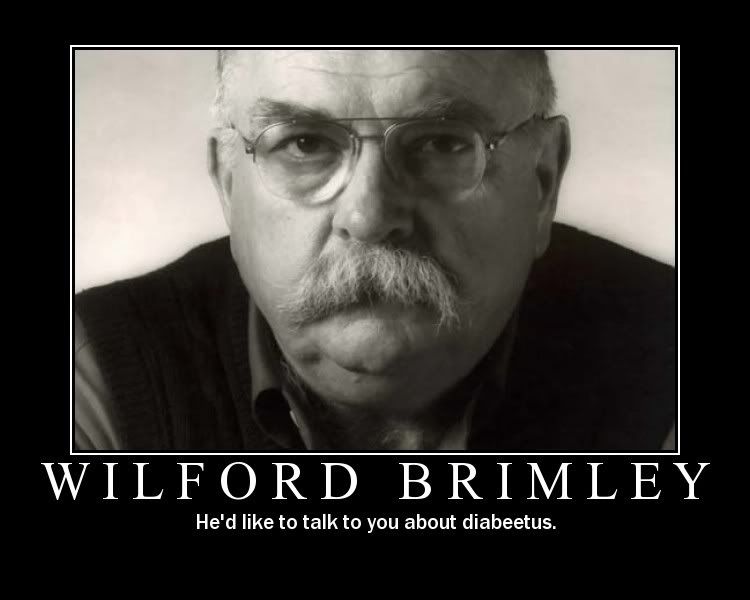
| (They also have this as a T-shirt with his picture, that simply says DIABEETUS.) |
But at least we have our own jam:
Poor Mr. Brimley. I really shouldn't find all of this so funny, but I DO.
I promised to explain Type 1 diabetes, so I will. (With graphics!) Are you ready?
First, here's some British kids with Type 1:
They do a good job of explaining the symptoms. The cause is annoyingly simple:
In a person with a healthy pancreas, a little bunch of cells at the bottom of the pancreas called the beta cells (also called "the Islet of Langerhans" for the person who discovered them--but I mean, "islet"? what, "island" was too lowbrow?) makes insulin. A bunch of different systems monitor your blood sugar--your liver, kidneys, pancreas, and brain all pay attention--and when it goes up, your beta cells release insulin to bring it back down. When it goes down, your liver releases glucose to make it go back up (until it uses up its glucose reserves and you are hungry, and your body tells you to eat). Simple, yes?
Basically Type 1 diabetes is an immune disorder. For some reason, your immune system takes it into its head that the beta cells in your pancreas are something to attack (much like this). Scientists are still speculating about exactly why the immune system starts doing something of no earthly use to anyone. It's sort of genetic but not really; it might be a virus (or it might not); or it might just be a mistake in the software, so to speak, in your killer T-cells.
Short answer: "Well, we know what happens, but danged if we know why, exactly."
(Type 2 diabetes works in a completely different way--they should really be classified as different diseases, but aren't because medicine keeps its historical diagnoses even after we realize they're dumb.)
So, in a Type 1 diabetic, they eat and the calories go into their bloodstream, but there is no insulin to get that nutrition actually into their cells. This leads to problems:
1) The cells are really, really hungry--especially the brain, which can only run on sugar. So you feel weak and fuzzy-headed. In Buddy's case, he lost a bunch of his fine motor control (coloring was where I noticed it) and he went backwards on his phonics. This makes sense when you realize he felt the same way that you do when you don't eat all day and then try to do something delicate--pen and ink drawing, say--at 5pm.
2) The amount of glucose (sugar) in the blood is really, really high, and the body does not like that--the kidneys, which did not get the memo that the pancreas is in trouble, manfully try to take up the slack and decide the answer is to pee off all the extra sugar. And electrolytes. And water. So you get--
3) Really really dehydrated, and
4) Your blood turns really, really acidic. This is what leads to the condition called Diabetic Ketoacidosis (DKA), which basically means that your blood is so acidic that it starts damaging your tissues (and brain). If DKA isn't corrected, you'll go into a coma and die. Yup.
The answer to all these problems? Insulin injections. Well, math and insulin injections.
Once you have insulin, the sugar can get into your cells, your kidneys can go back to doing their old job, your liver doesn't keep dumping glucose that you don't need into your blood, you can think, use your fingers for fine tasks, and run and jump and climb trees.
One big difference between type 2 diabetes and type 1 is that type 2 can improve when you lose weight and exercise. Not type 1--while you should try, of course, to be active and eat healthy as a type 1, you can be a professional athlete and it still won't make your pancreas start working again. Right now there is no cure.
However, medicine has been expecting to find a cure for years. It seems like a disease that you should be able to solve with, say, transplanted beta cells, or cloned beta cells, or something. You can, reading the professional literature, almost taste the researchers' frustration.
What's a day in the life like?
We get up and, by 8am, check Bud's blood sugar with a fingerstick glucometer that has a cool feature--it lets you download the sugars to your computer. Then I make him breakfast and he gets two kinds of insulin:
-long acting insulin called Lantus--this mimics the baseline of insulin that a healthy pancreas keeps in your bloodstream all the time. He only has to have Lantus in the morning right now.
-short acting insulin called Humalog--this mimics the spike in insulin that you get after you eat and your blood sugar goes up. This insulin he gets whenever he eats, and this is the one that needs the calculations done.
For instance, this morning he had scrambled eggs (0g carbs) and toast (15g for one slice) with butter (0g) for breakfast. His insulin ratio is 1/2 unit of Humalog for every 15g carbs he eats. So normally I would give him an injection of 1/2 unit of Humalog. (This is an extremely small dose, by the way.)
BUT--here is where the math comes in--this morning when he woke up his blood sugar was low (71). The doctors gave us a range in which to keep it (100-200). So instead of giving him short-acting insulin this morning, I gave him juice (15g for half a cup). Then I waited 15 minutes, checked his sugar again (he was still low--84) and let him eat his toast without short-acting insulin.
You can see how things get a bit wild and wooly. He's been low all day, actually. Me and the diabetes nurse chatted (I get to call them any time, day or night, that I want) and agreed that Buddy's insulin dose was too high, and we lowered it. We'll be measuring again at lunch, dinner, snack, and bedtime--and any time in between that Buddy starts acting fussy, hungry, sleepy, or weird. (I mean, more fussy, hungry, sleepy, and weird than your average four-year-old.)
If all of that still makes you scratch your head, try reading this book. It's very clear and easy to understand, and is the best type 1 book I've found yet.
Short synopsis? We're doing fine and getting used to it. Yesterday we went to our play group, McDonald's, and soccer, and managed the insulin just fine. Life goes on...just with more math. (Praise God.)
Cheers,
Breanna


1 comment:
A couple of things:
1) Aren't you afraid of making Wilford Brimley angry? I would be. I hear he can whip bowls of Quaker Oats at people ninja fast.
2)Thank you for making "Diabeetus" so easy to understand. I know I won't be preparing any meals for Buddy in the near future but it makes me feel better.
Love you guys
-Kindra
Post a Comment